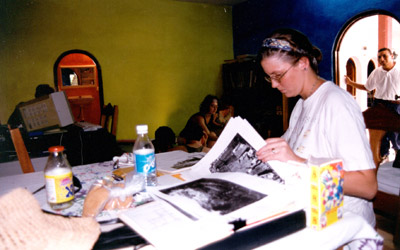
Field School in Experimental Ethnography 1994-1999
Dr. Castañeda began taking students to Yucatán during
the summers to learn about Maya peoples, culture, history and ethnography
in 1994 (see student successes).After three
field seasons, 1994-1996, the ethnographic training program was re-structured
as the Field School in Experimental Ethnography. This project combined
the goals of research and teaching in an innovative program. Students
took courses in ethnographic methods and cultural anthropology while
learning how to do fieldwork. Student researchers focused their participation
in one of three projects:
Two overarching principles governed its conceptual design and organization.
First, the Field School program combined intensive and long term field
research with a pedagogical agenda of training students in ethnographic
fieldwork. Second, the Field School program sought to both theorize
and put into practice a mode of ethnography that it called experimental
ethnography. While this term has come to refer to a movement focused
on issues of representation in ethnographic writing, it is used here
to refer to an emergent theory and practice of fieldwork.
Experimental ethnography is a paradigmatic mode of fieldwork in which
given, prior and assumed knowledges are used and recirculated in fieldwork
activities, dynamics, and practices with the goals of actualizing an
ethnographic process that both a) has relevance to and for the communities
with which research is conducted and b) experiments with the very practices
of fieldwork itself with the aim of theorizing, and reconfiguring alternative
forms of, ethnography.
Ethnography Field School
The Field School in Experimental Ethnography completed its research projects in 2000 after three successful field seasons. In three summer seasons of research, the program trained more than 30 undergraduates and five graduate students and worked in three areas of investigation indicated above.
Based on a re-newed collaboration with Dr. Juan Castillo Cocom beginning in 2000, the Field School was transformed into and re-inaugurated as The Open School of Ethnography and Anthropology. In 2003 the Field School
in Experimental Ethnography was re-designed and re-inaugurated as OSEA
or The Open School of Ethnography and Anthropology under the auspices
of the CITE — The Community Institute of Transcultural Exchange.
Dr. Castillo Cocom taught at the Universidad
Nacional Pedagógica UPN (2005-2008) and is currently teaching at the Universidad Intercultural Maya de Quintana Roo UIMQRoo (2009-present). Dr. Castillo Cocom continues to collaborate with OSEA on research projects, collaborative teaching and publications. His students the UIMQRoo are often involved in OSEA teaching, research and conference projects.
Castaneda has been on the licientiatura thesis committe of several of his students, including Edy Dzidz, who graduated in 2013 from the UIMQRoo. Edy's research was a study of memory and history based on a comparative analysis of the way anthropologists have imagined the Maya of the community of Tusik and the way members of the community of Tusik imagine and narrate their own histories and memories.
OSEA Programs (1997-2008)
Our History
OSEA and its antecedent organization, the Field School in Experimental
Ethnography, have provided graduate and undergraduate students a unique
learning experience since 1997. Through our programs we have and continue
to provide students with an invaluable, on-site, hands-on interactive
training in research methods and ethnographic fieldwork. Successful students have used their training and experience from OSEA and the Field School in Experimental Ethnography to go on to graduate programs at Stanford, Rice University, Michigan, the New School. Their experiences have helped them develop new or accelerated career paths in TESL, the anthropology of education, visual anthropology, and other fields. Click here to learn more about OSEA History, Student Success, and On-Going Research Endeavors
Spring Writer’s Workshop (2004) The Ethnography Writer’s Workshop is not a fieldwork based program. The Workshop is an intensive period of writing on one’s own projects within an atmosphere of collaborative support, constructive commentary, intellectual focus created by the OSEA staff and the other participants who are similarly engaged in their own writing. The Workshop is ideal for any culture-focused writer seeking to complete a journal article, revise a book, write a dissertation or thesis, or prepare a research proposal or report.